Es muy tarde! / It’s too late! AYOP

     We will end el módulo con (with) la hora (the time). Es muy importante (it is very important) to know how to say, understand and ask for the time.

     Maybe you want to go to a Museum and you need to ask what time it closes, or you go to the cinema and you don’t know what time the film is being shown. 

     If the hotel tells you the time to check out and you don’t understand, you may have to pay a surcharge if you leave later!

     There will be many situations in which you need to know la hora, or do you want to miss breakfast at your hotel? No, right? 

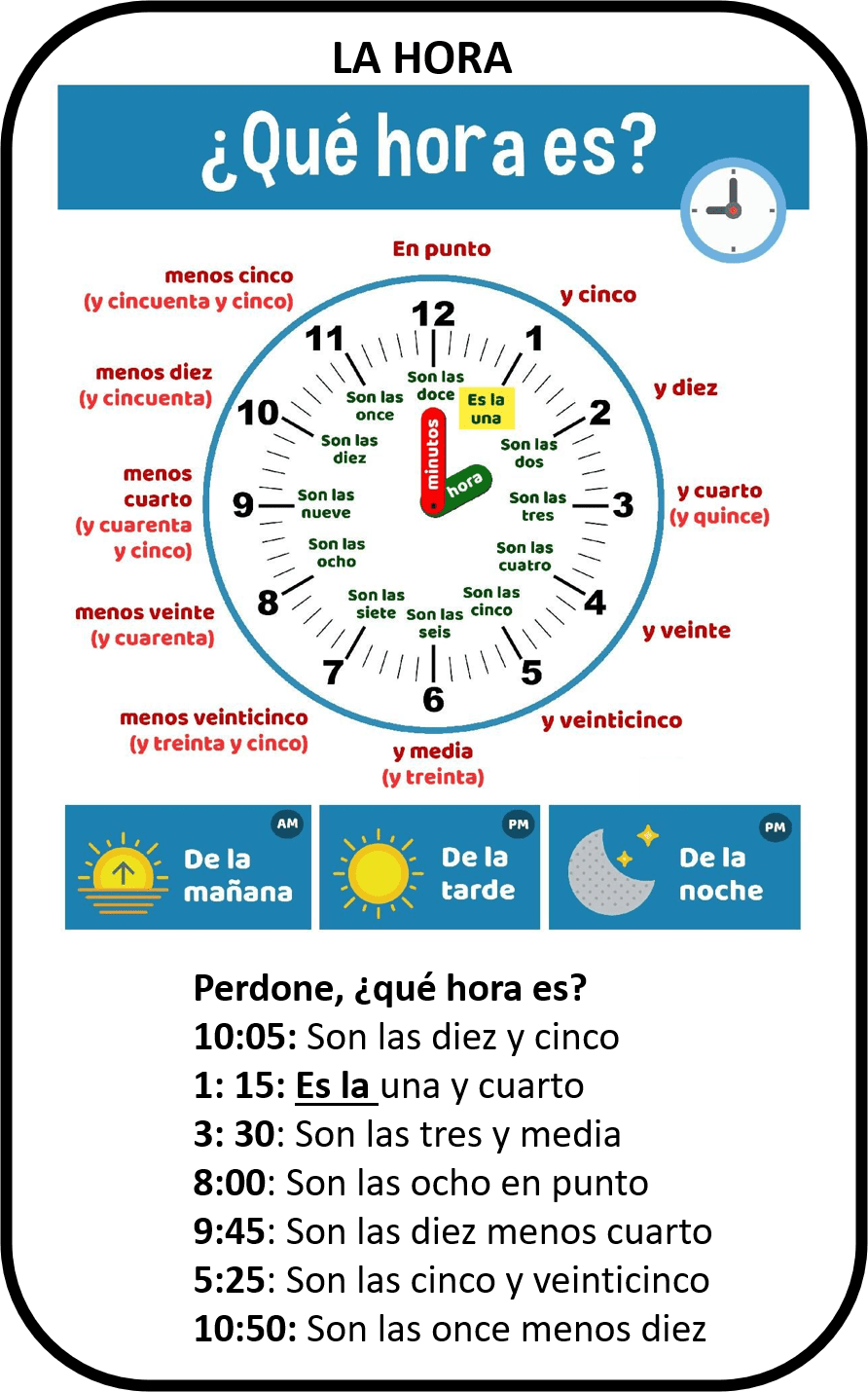
     Well, let’s go. It is very easy, you will not have any trouble learning it quickly. And I have such a fantastic graphic that you only have to look at it to understand:


     If you have looked at the image carefully, you will have realized that it is muy fácil (very easy). There are only tres things you must remember:

     1. To ask, we say: ¿Qué hora es?  what time is it? And the answer is son las for all hours, because they are plural, and es la unafor 1:00, because it is an hour in singular. If we translate it literally, “es la una” means “it is one o´clock” because it is an hour in the singular, andson las … means “they are” for all the others, because they are hours in the plural. Remember: es la una” – “son las…” 

     1:20 → Es la una y veinte

     8:10 → son las ocho y diez

      2. Los minutos (the minutes) are said with the number, normally using y (and) when they are “positive” (it is like saying in English “it is two and twenty minutes”), and usingmenos when they are “negative”, literally “it is seven minus ten minutes“:

     3:05 → Son las tres y cinco (and) 3h + 5 min

     5: 50 → Son las seis menos diez (minus)  6h – 10 min 

     3. There is a special way to say “o’clock” and “quarter” hours: en punto (o’clock), y cuarto (+ quarter past), y media (and a half), menos cuarto (- quarter to).

     7:00 → Son las siete en punto

     9:15  Son las nueve y cuarto

     2:30  Son las dos y media

     12:45  Es la una menos cuarto (1 hour minus one quarter)

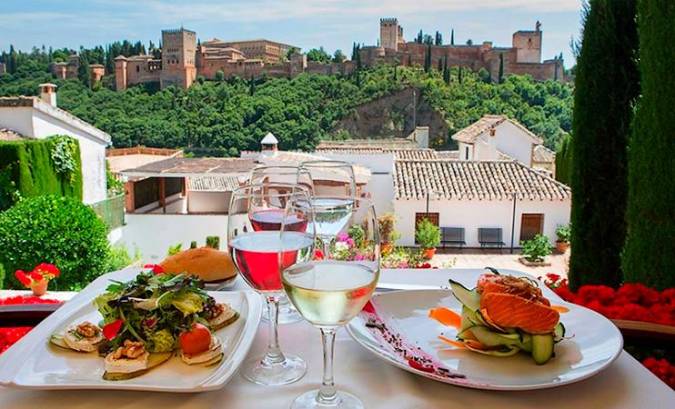
Views of “La Alhambra” in Granada from a restaurant 

     As I said, in Andalusia we eat and dine very late, which is usually a huge advantage for the tourists who visit us, because if you go to a restaurant to eat at 12:30, you will have all the tables available for you (and for the other tourists who are hungry at the same time as you, hehe).

     And if you can also eat with the views you see in the picture next to you, do you still have to think if you want to come to Andalusia?

     When we do not want to ask the time at that moment, but we want to ask at what time does any event will take place (breakfast, concert, theater …) we ask: ¿ A qué hora es …? :

  • ¿A qué hora es el desayuno? = What time is the breakfast?
  • ¿A qué hora es la película? = What time is the movie?
  • ¿A qué hora es el teatro? = What time is the theater?
  • ¿A qué hora es el check out? = What time is the check out?
      

     As in Spain we do not say “it is 18 hours: son las dieciocho horas” but “it is 6: son las seis“, we usually specify if we speak about the morning (de la mañana), the evening (de la tarde) or at night (de la noche). Here you have some examples:

  • ¿A qué hora es el check out? A las 12 de la mañana

    – What time is the check out? At 12 o´clock in the morning

  • ¿A qué hora es la cena? A las 9 y media de la noche

    – What time is the dinner? At 9,30 at night

  • ¿A qué hora abre (abrir = open) la catedral? Abre a las 10 de la mañana

   – What time does the cathedral open? It opens at 10 in the morning


¡ATENCIÓN!
      In Spanish, we use the word “mañana" for “morning” and for “tomorrow”. So we could say: “mañana por la mañana ” (tomorrow morning). See the ejemplos below:

  • Mañana por la mañana vamos a desayunar en esa cafetería

     – Tomorrow morning we are going to have breakfast in that cafeteria

  • Mañana por la mañana vamos a visitar la catedral

     – Tomorrow morning we are going to visit the cathedral

  • Mañana vamos a ver el alcázar por la mañana y la Giralda por la tarde

     – Tomorrow we will see the Alcázar in the morning and la Giralda in the afternoon


Tip
     You can use the verb “IR + A ” to talk about the future without having to learn the future tenses. Just by writing the verb IR plus the preposition A followed by an infinitive verb, you will already be talking in the future!
All the sentences above speak of the future tense using the present. But don't worry, we will see this later and you will learn the verb IR  (to go).

     Ok, ahora it’s time to practise la hora. Go below and do los ejercicios. Surely you´ll do it very well because it is very easy and it is the last effort!

     Well, you have finished el módulo. You have made a great effort y have learned a lot of things. Not only things like los días de la semana, las preguntas or los colores, but you have also been learning very common words like:

Y = and

Pero = but

Que = that

Con = with

Sin = without

Hay = there is-are

De = of

Siempre = always

Por favor = please

Aquí = here

Ahora = now

Ejercicio = exercice

Cuaderno = notebook

Palabra = word

Atención = attention

Muy = very

Importante = important

Fácil = easy


     Ahora (now) go and do the exercises below to practice this words once.

     Now the last step. Click on the button below to access the quiz. When you finish, you will gain access to the next módulo when it is released. Buena suerte! (Good luck!)